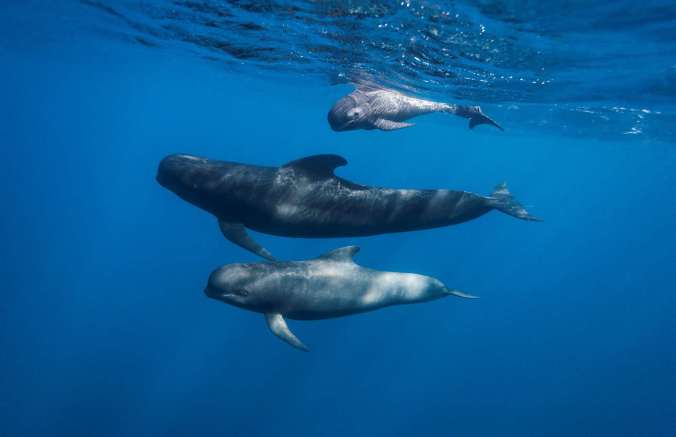
Join the ABA ILS International Criminal Law Committee and ILS International Animal Law Committee for the final webinar in our Blue Crimes series focused on crimes impacting aquatic animals, humans and our environment. This webinar is free and open to the public.
Peter Hammarstedt is the Chief Campaigns Officer for Sea Shepherd Global, an international nonprofit organization that supports law enforcement authorities to tackle illegal fishing through blue water interdictions. In 2014, Peter Hammarstedt captained a ship that set the record for longest maritime pursuit in history, chasing an internationally-blacklisted vessel across three oceans and 10,000 miles before it was intentionally sunk by its captain off the coast of São Tomé and Príncipe.In the wake of the sinking, Peter created and piloted a “civilian offshore patrol vessel” program to support developing countries in efforts to combat illegal, unreported and unregulated (IUU) fishing in their sovereign waters and sustain the health of the ocean.
Alana MalindeS.N. Lancaster is a Guyanese-Barbadian environmental, energy & human rights lawyer, academic and natural resources specialist. She is currently a Lecturer in International Environmental & Energy Law, and Head of the Caribbean Environmental Law Unit of the Faculty of Law, The University of the West Indies, Cave Hill Campus. Alana is also a Researcher with the UKRI GCRF-funded One Ocean Hub, and serves as the Regional Director of the Global Network for Human Rights and the Environment for the Caribbean Region. Since 2014, she has been a Member of the International Law Association Caribbean Branch and currently serves on the Branch’s Executive. In addition to er research, Alana has also contributed extensively to the work of international bodies, courts and the work of the Special Rapporteurs on human rights and climate change, and the right to a healthy environment.
Amy P. Wilson is a licensed attorney of the High Court of South Africa and researcher with over 14 years of professional legal experience. She is the co-founder and director of Animal Law Reform South Africa, the first dedicated animal law non-profit in the country. She is a Lecturer and Research Associate with the University of Johannesburg and a Senior Adjunct Lecturer with the University of the Western Cape. She is consultant on aquatic animal law issues for the Animal Legal Education Initiative at The George Washington University Law School. Amy is an Independent Expert with the United Nations in Harmony with Nature Programme and a founding steering committee member of the Global Alliance for the Rights of Nature: Africa Hub. She holds bachelor’s degrees in business management and law, a Master’s degree in Animal Law and is currently working towards her Doctorate.
Jamie McLaughlin (moderator) is the Co-Chair of the ABA ILS Animal Law Committee.
This program is free and open to all. Please register in advance here: https://bit.ly/4bxSiXv
The International Criminal Court (ICC) was created to respond to international crimes. Over the last 25 years, the ICC has navigated both progress and setbacks and now faces a series of challenges, many driven by state actions. These challenges include the enforcement of arrest warrants, state responses to the Prosecutor’s jurisdictional assessments, and the ICC’s ability to deter international crimes.
This discussion will assess these challenges and their impact on the ICC’s effectiveness, exploring whether they can be addressed given their consequences for victims’ rights and access to justice. The discussion will also consider whether state resistance arises from a misunderstanding of the law or signals deeper structural challenges that must be resolved for the ICC to function effectively.
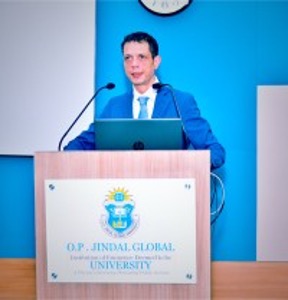
Dr. Pierpaolo Petrelli
Dr. Pierpaolo Petrelli is an Associate Professor and Associate Dean (International Internship) at O.P. Jindal Global University School of Law. Mr. Petrelli has over eight years of work experience as a legal counsel in governmental and non-governmental organizations. His area of research interest focuses on international law, international criminal law, international human rights law (IHRL), international humanitarian law (IHL), European law, transnational terrorism, and refugee law. He specializes in providing advice to governments, international organizations, corporations, and communities on how to comply with IHRL and IHL, manage human rights risks and how seek redress in the international human rights and criminal law system. His work involves advising on all aspects of accountability and human rights due diligence, human rights investigations and fact-finding missions throughout the globe. Mr. Petrelli is an expert in the law and procedure of international tribunals, including the International Criminal Court (ICC) and the International Court of Justice (ICJ) in relation to allegations and prosecution of international crimes. He has also practiced as a defense attorney in Italy and United States law firms.
Rebecca Shoot
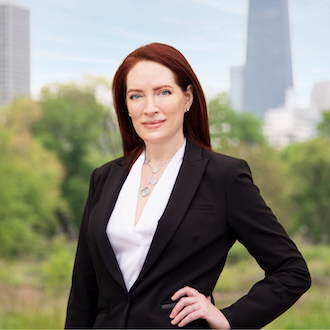
Rebecca A. Shoot is an international lawyer and democracy and governance practitioner with more than 15 years of experience in the non-governmental, inter-governmental, and private sectors supporting human rights, democratic processes, and the rule of law on five continents.
In nearly a decade with the National Democratic Institute (NDI), Rebecca held numerous positions in headquarters and the field supporting and leading democracy and governance programs in Central and Eastern Europe and Southern and East Africa. She subsequently moved to a leadership role steering NDI’s Governance projects globally and directing programming for the bipartisan House Democracy Partnership of the U.S. House of Representatives. Rebecca created a global parliamentary campaign for Democratic Renewal and Human Rights as Senior Advisor to Parliamentarians for Global Action (PGA), an international network of legislators committed to collaboration to promote democracy, human rights, and the rule of law. Prior to that, she directed PGA’s International Law and Human Rights Programme and ran PGA’s office in The Hague. Most recently, she helmed global programming to promote gender equality and criminal justice reform for the American Bar Association Rule of Law Initiative (ABA ROLI).
Rebecca earned a Juris Doctorate with Honors from Emory University School of Law, where she received several academic distinctions, including the David J. Bederman Fellowship in International Law and Conley-Ingram Scholarship for Public Interest Leadership. She earned a Master of Science in Democracy & Democratisation from University College London School of Public Policy and a Bachelor of Arts Magna Cum Laude in Political Science from Kenyon College. She holds certificates in Conflict Analysis from the U.S. Institute of Peace and in Public International Law from The Hague Academy of International Law.
As Executive Director of CGS, Rebecca will continue her current role as Co-Convener of the Washington Working Group for the International Criminal Court (WICC), a diverse coalition of human rights organizations, legal associations, former government officials, and leading legal professionals. CGS and WICC have a rich and intertwined history that this dual appointment brings full circle, with CGS formerly serving as host for the coalition and with several current and former common Board and National Advisory Committee members.
She also acts, directs, and writes for the theater.
Dr. Denakpon L. Tchobo
Dr. Denakpon L. Tchobo GJIE- Chief Executive Officer Dr. Denakpon Tchobo is the Co-founder and Chief Executive Officer of Global Justice Intelligence Eyes. Inc., an NGO that focuses on research, investigative work, and legal assistance for victims of international crimes and human rights violations worldwide. He is an international criminal lawyer admitted to the list of Assistants to Counsel at the International Criminal Court in the Hague. Dr. Tchobo is also an adjunct law professor at Case Western Reserve University School of Law, where he has co-coached the ICC Moot Court Team since August 2021. Passionate about human rights protection and promotion as a victims’ activist, Denakpon joined Amnesty International in Benin, West Africa, where he worked as a volunteer, human rights defender, and local coordinator on several projects, such as the abolition of the Death Penalty in Benin, Torture, LGBTQ rights, Stop Violence Against Women, Health and sexual reproductive Rights, Trade and Arms Control, International Justice, Education, and Children’s Rights from November 2010 to April 2014. He also served on the Organization Elective Board Committee as a second Reporter in 2014. He has authored books and many articles on genocide and international criminal law issues, including the proposed convention on the new international crime he called groupicide.
Dr. Denakpon Tchobo is a precursor of the conciliation of the interests of justice and the interests of victims in the proceedings of international criminal justice. On November 24, 2023, he was invited by the Kharkiv National University of Internal Affairs to speak at an International scientific and practical conference before Madam State Secretary of the Ministry of Internal Affairs of Ukraine, the Presidium of the University, law enforcement bodies, lawyers, Professors, and students to help war crimes Prosecutors and law enforcement bodies conduct a proper quality of pre-trial investigation under martial law in favor of victims of war crimes committed by the Russian Federation on the territory of Ukraine.
Join the ABA ILS International Criminal Law Committee and ILS International Animal Law Committee for this second of a three-part webinar series on Blue Crimes impacting aquatic animals, humans and our environment.
SPEAKERS:
ALEX CORNELISSEN Chief Executive Officer, Sea Shepherd Global
KATHY HESSLER Director, Animal Legal Education Initiative The George Washington University Law School
LU SHEGAY Co-Founder and Managing Director, Institute of Animal Law of Asia
JAMIE MCLAUGHLIN Moderator ABA ILS International Animal Committee
Read the 2020 American Bar Association Resolution that calls on governments at all levels to enact and enforce laws banning the possession, sale, and trade of shark fins and urges legal organizations to advocate for and promote these measures globally.
The start of 2025 offers fresh opportunities for innovation and collaboration. As we look ahead, we reflect on the milestones that have set our foundation for the future.
In 2024, the House of Delegates unanimously adopted two pivotal resolutions. Resolution 501, addressing the genocide of the Hazara people in Afghanistan, originated from our Co-Chairs’ groundbreaking white paper, Broken Frame, Shattered Glass: Recognizing Crimes Perpetrated Against the Hazaras of Afghanistan — the first such initiative in the International Law Section’s history. Resolution 502 called for international action on human rights violations in Tibet, further establishing ICLC’s role in shaping global policy.
As 2025 begins, the ICLC is turning its attention to the critical issue of state responsibility. In 2001, the International Law Commission produced Responsibility of States for Internationally Wrongful Acts, a document that, while never formalized into a convention or treaty, continues to influence judgments from international tribunals. This topic takes on heightened importance this year, as the International Court of Justice faces multiple cases that question the responsibility of states. Meanwhile, the International Criminal Court remains focused on prosecuting individuals for criminal acts, raising questions about the interplay between state and individual accountability.
This explores key questions related to state responsibility, including its effectiveness, what has transpired in practice, and what may be expected by international courts and tribunals as these pivotal cases unfold in the coming year.
Nations on Trial: Examining State Responsibility in International Justice was broadcast as a live webinar on January 15, 2025. Watch the recording on our YouTube channel.
This webinar was presented on Monday, December 16, 2024. You can watch the recording here or on our YouTube channel.
The use of Universal jurisdiction as a tool international criminal justice has continued to grow over the years, and 2024 was no exception. Universal jurisdiction remains an important tool in addressing impunity and specifically prosecuting perpetrators for crimes under international criminal law.
Join the International Criminal Law Committee for the last webinar of 2024, focusing on Universal Jurisdiction developments for 2024. If you have not been paying attention and want a primer, this is the webinar for you!
Moderated by: Henna Shah. ICLC Steering Committee
Speaker: Marisa R. Bassett
Marisa R. Bassett is an Institutional Capacity Building Attorney at the Defense Institute of International Legal Studies (DIILS). In this role, she assists foreign partner defense institutions in Eastern Europe in building legal capacity, including on the law of armed conflict and human rights. Before joining DIILS, Marisa was Assistant Appeals Counsel with the International Residual Mechanism for Criminal Tribunals—the successor to the International Criminal Tribunals for the former Yugoslavia (ICTY) and Rwanda (ICTR)—where she prosecuted major political and military leaders for genocide, war crimes, and crimes against humanity. She previously served in the ICTY’s Office of the Prosecutor, Appeals Division.Marisa is a member of the Justice Rapid Response roster of experts on investigating sexual violence in conflict. She is co-editor of Economic Sanctions under International Law: Unilateralism, Multilateralism, Legitimacy, and Consequences (Asser 2015).
This program was recorded as a live webinar on November 25, 2024. Watch it in its entirety here or on our YouTube channel.
The ABA ILS International Criminal Law Committee and ILS International Animal Law Committee present the first of a three-part webinar series on Blue Crimes impacting aquatic animals, humans and our environment.
Valentina Crast is the Campaign Director for Sea Shepherd, Faroe Islands. She has been an animal rights advocate for 12 years, working in various roles, including leading pressure campaigns and conducting investigations. She also ran for the European Parliament in 2024, focusing entirely on animal advocacy. Valentina began her long-term commitment to Sea Shepherd’s efforts to end whaling in 2012, spending four months in Japan documenting the slaughter and captivity trade in Taiji. As Campaign Director for Sea Shepherd’s work in the Faroe Islands, Valentina oversees on-the-ground activism, secures documentation, and gathers evidence related to the Faroese drive hunts. Additionally, Valentina represents Sea Shepherd in The Stop the Grind Coalition, focusing on collaborative political pressure on the Government of the Faroe Islands within the European Parliament, and exploring legal strategies to end whaling in Europe.
Zoi Aliozi is an international academic, lawyer, and activist specializing in climate justice, and human rights education, through the disciplines of law and philosophy. Based in Europe, she is a cosmopolitan thinker who has spent the last two decades living, studying, and working across multiple countries globally. Her interdisciplinary PhD research on state-terrorism earned her the First Award for Young International Philosophers. Before transitioning to academia, she practiced criminal law, which continues to inform her research and teaching. Her unique ability to bridge legal practice with academic theory makes her an influential voice in both fields. Dr. Aliozi’s passion for criminal law extends into her research on climate justice, human rights, animal rights, and the rights of nature, approached through the lens of international criminal law (ICL). Her recent work focuses on integrating criminal law concepts, such as ecocide, into climate justice theory. With over two decades of teaching experience at top universities, Dr. Aliozi blends legal expertise, philosophical insights, and climate justice advocacy to shape international human rights education, global policy, and academic thought. Dr. Aliozi currently serves as an EU Climate Pact Ambassador, raising awareness of the climate crisis and advancing green education on climate justice by driving meaningful climate action. She has contributed to the creation of the ‘Maastricht Principles for the Rights of Future Generations‘ and serves as a senior research evaluator for climate justice within ‘Horizon Europe‘ at the European Commission. In 2024, Dr. Aliozi founded ZA Global Academic & Comms Consultancy, providing expert academic services in human rights and climate justice education, and policy advisory, and using cutting-edge digital tools to drive meaningful impact through eComms.
Lori Marino is a neuroscientist formerly on the faculty at Emory University in Atlanta. She is currently Adjunct Professor of Animal Studies at New York University, where she teaches graduate courses on Captive Wild Animal Welfare and the Psychology of Human Exceptionalism. She is the founder and President of the Whale Sanctuary Project and Executive Director of The Kimmela Center for Scholarship-based Animal Advocacy. Lori’s scientific work focuses on the evolution of the brain and intelligence in dolphins and whales (as well as primates and farmed animals), and on the effects of captivity on wild animals. She has published over 140 peer-reviewed scientific papers, book chapters, and magazine articles in these areas. Lori also works at the intersection of science and animal law and policy and is the Co-Director (with Professor Kathy Hessler) of the Animal Law and Science Project at George Washington University and Adjunct Professor at the Vermont Law and Graduate School.
She has a bachelor’s degree from Barnard College in chemistry, a master’s degree from MIT in technology policy, and a doctorate from Harvard University in public policy. She is a 2016 graduate of the Massachusetts Institute of Psychoanalysis.
Dr. Stern’s contributions to both academia and government make her a uniquely authoritative voice on terrorism, bringing together deep theoretical knowledge and real-world experience.
This program was recorded on October 30, 2024. Watch the recording here or on our YouTube channel.
The term mass grave lacks a universally accepted legal definition in international law. However, various legal instruments under international humanitarian law, including Additional Protocol I, aim to promote the protection of mass graves and ensure the dignity of the deceased.
As participants will recall, the first webinar in this series focused on context-specific issues and broad challenges related to mass graves, highlighting how human rights leaders and lawyers in affected communities have responded to these situations. The second webinar now focuses on principles, protocols, and international law, assessing how these protocols and guidelines work, how determinations are made, and what more needs to be done to protect the dignity of the dead.
Dr Melanie Klinkner is an international law scholar and, together with Dr Ellie Smith, author of the Bournemouth Protocol on Mass Grave Protection and Investigation. Since October 2023 she is working on an 5 year-long, £1.6 million project to develop a comprehensive human rights framework for Mass Grave Protection, Investigation and Engagement (MaGPIE). She led an Arts and Humanities Research Council Research Leaders Fellowship for the creation of mass grave protection guidelines with the International Commission on Missing Persons (ICMP) as project partner. In addition, she was the Principal Investigator on a Global Challenges Research Fund project on how to humanise the process of mass grave protection and investigation from the representative perspective of victims’ families. She also led a Leverhulme funded project to explore the merit of open source mass grave mapping. Together with Dr Howard Davis she is author of the monograph ‘The Right to the Truth in International Law’ (published by Routledge, 2020). During Trinity Term 2018 she was a Research Visitor at Oxford University’s Bonavero Institute of Human Rights. She is a Fellow of the Academy of Social Science and since February 2021 a member of the ‘Panel of Experts on Missing Persons‘ for the ICMP. At Bournemouth University she teaches public international law, international criminal law and international human rights law.
Sarah Knuckey joined Columbia Law School in July 2014 as faculty co-director of the Human Rights Institute, director of the Human Rights Clinic, and the Lieff Cabraser Clinical Professor of Law. Knuckey is an international human rights lawyer, professor, and special adviser to the U.N. special rapporteur on extrajudicial executions. She has carried out fact-finding investigations and reported on human rights and armed conflict violations around the world, including in Afghanistan, Brazil, the Central African Republic, Colombia, the Democratic Republic of the Congo, Kenya, Papua New Guinea, and the United States. Her research and advocacy focus on issues such as unlawful killings, sexual violence, and corporate accountability. Knuckey is a founding editor of Just Security, an online forum for analysis of U.S. national security law and policy. She has been awarded the Fulbright Postgraduate Award, the Murphy Postgraduate Scholarship, the Harvard Human Rights Program Fellowship, the Parsons Memorial Prize for Law, and the KCF Keall Prize in Law.
The panel was moderated by Tim Franklin, Co-Chair of the International Criminal Law Committee.
Mahmood Amiry-Moghaddam, Director of Iran Human Rights, and Shadi Amin, Executive Director of the LGBTI network 6Rang, highlight the severe human rights abuses in Iran, including its position as the second-largest executioner globally, with the highest rates of executions for women, juveniles, and ethnic minorities like Baluchis and Kurds. Amiry-Moghaddam points to the use of the death penalty as a political tool to suppress dissent, particularly following protests, with confessions often obtained through torture and a judiciary lacking independence. Amin emphasizes the persecution of the LGBTI community, where consensual same-sex conduct can lead to execution, and connects this repression to the Women, Life, Freedom movement sparked by Mahsa Amini’s death, calling for international action to abolish the death penalty and end state-sanctioned violence against marginalized groups.














 International Criminal Law Committee