February 13, 2025 at 12:00 PM EST
The International Criminal Court (ICC) was created to respond to international crimes. Over the last 25 years, the ICC has navigated both progress and setbacks and now faces a series of challenges, many driven by state actions. These challenges include the enforcement of arrest warrants, state responses to the Prosecutor’s jurisdictional assessments, and the ICC’s ability to deter international crimes.
This discussion will assess these challenges and their impact on the ICC’s effectiveness, exploring whether they can be addressed given their consequences for victims’ rights and access to justice. The discussion will also consider whether state resistance arises from a misunderstanding of the law or signals deeper structural challenges that must be resolved for the ICC to function effectively.
Dr. Pierpaolo Petrelli
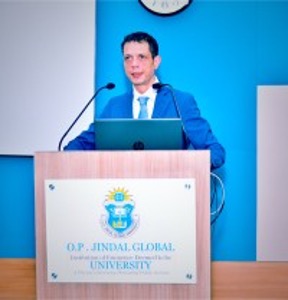
Dr. Pierpaolo Petrelli is an Associate Professor and Associate Dean (International Internship) at O.P. Jindal Global University School of Law. Mr. Petrelli has over eight years of work experience as a legal counsel in governmental and non-governmental organizations. His area of research interest focuses on international law, international criminal law, international human rights law (IHRL), international humanitarian law (IHL), European law, transnational terrorism, and refugee law. He specializes in providing advice to governments, international organizations, corporations, and communities on how to comply with IHRL and IHL, manage human rights risks and how seek redress in the international human rights and criminal law system. His work involves advising on all aspects of accountability and human rights due diligence, human rights investigations and fact-finding missions throughout the globe. Mr. Petrelli is an expert in the law and procedure of international tribunals, including the International Criminal Court (ICC) and the International Court of Justice (ICJ) in relation to allegations and prosecution of international crimes. He has also practiced as a defense attorney in Italy and United States law firms.
Rebecca Shoot

Rebecca A. Shoot is an international lawyer and democracy and governance practitioner with more than 15 years of experience in the non-governmental, inter-governmental, and private sectors supporting human rights, democratic processes, and the rule of law on five continents.
In nearly a decade with the National Democratic Institute (NDI), Rebecca held numerous positions in headquarters and the field supporting and leading democracy and governance programs in Central and Eastern Europe and Southern and East Africa. She subsequently moved to a leadership role steering NDI’s Governance projects globally and directing programming for the bipartisan House Democracy Partnership of the U.S. House of Representatives. Rebecca created a global parliamentary campaign for Democratic Renewal and Human Rights as Senior Advisor to Parliamentarians for Global Action (PGA), an international network of legislators committed to collaboration to promote democracy, human rights, and the rule of law. Prior to that, she directed PGA’s International Law and Human Rights Programme and ran PGA’s office in The Hague. Most recently, she helmed global programming to promote gender equality and criminal justice reform for the American Bar Association Rule of Law Initiative (ABA ROLI).
Rebecca has spoken at high-level conferences and events on five continents (and increasingly, globally through online platforms). Her publications include the first Global Parliamentary Report (IPU & UNDP 2012), Political Parties in Democratic Transitions (DIPD 2012), and Navigating between Scylla and Charybdis: How the International Criminal Court Turned Restraint Into Power Play (Emory Int’l L. Rev. 2018), which was honored with the Emory International Law Review’s Founder’s Award for Excellence in Legal Research and Writing.
Rebecca is admitted to practice law in the District of Columbia and is a member of several bar associations, including the American Branch of the International Law Association (ABILA), where she serves as Advocacy Director for the International Criminal Court (ICC) Committee. She served as a Visiting Professional in the Presidency of the ICC and has provided pro bono legal expertise to The Carter Center, International Refugee Assistance Project, United Nations Working Group on Enforced and Involuntary Disappearances, and U.S. Marine Corps University, where she helped develop the international humanitarian law curriculum.
Rebecca earned a Juris Doctorate with Honors from Emory University School of Law, where she received several academic distinctions, including the David J. Bederman Fellowship in International Law and Conley-Ingram Scholarship for Public Interest Leadership. She earned a Master of Science in Democracy & Democratisation from University College London School of Public Policy and a Bachelor of Arts Magna Cum Laude in Political Science from Kenyon College. She holds certificates in Conflict Analysis from the U.S. Institute of Peace and in Public International Law from The Hague Academy of International Law.
As Executive Director of CGS, Rebecca will continue her current role as Co-Convener of the Washington Working Group for the International Criminal Court (WICC), a diverse coalition of human rights organizations, legal associations, former government officials, and leading legal professionals. CGS and WICC have a rich and intertwined history that this dual appointment brings full circle, with CGS formerly serving as host for the coalition and with several current and former common Board and National Advisory Committee members.
She also acts, directs, and writes for the theater.
Dr. Denakpon L. Tchobo
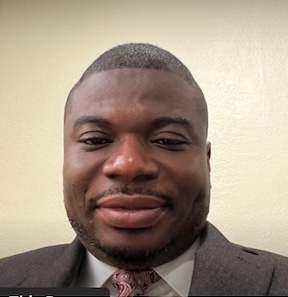
Dr. Denakpon L. Tchobo GJIE- Chief Executive Officer Dr. Denakpon Tchobo is the Co-founder and Chief Executive Officer of Global Justice Intelligence Eyes. Inc., an NGO that focuses on research, investigative work, and legal assistance for victims of international crimes and human rights violations worldwide. He is an international criminal lawyer admitted to the list of Assistants to Counsel at the International Criminal Court in the Hague. Dr. Tchobo is also an adjunct law professor at Case Western Reserve University School of Law, where he has co-coached the ICC Moot Court Team since August 2021. Passionate about human rights protection and promotion as a victims’ activist, Denakpon joined Amnesty International in Benin, West Africa, where he worked as a volunteer, human rights defender, and local coordinator on several projects, such as the abolition of the Death Penalty in Benin, Torture, LGBTQ rights, Stop Violence Against Women, Health and sexual reproductive Rights, Trade and Arms Control, International Justice, Education, and Children’s Rights from November 2010 to April 2014. He also served on the Organization Elective Board Committee as a second Reporter in 2014. He has authored books and many articles on genocide and international criminal law issues, including the proposed convention on the new international crime he called groupicide.
Dr. Denakpon Tchobo is a precursor of the conciliation of the interests of justice and the interests of victims in the proceedings of international criminal justice. On November 24, 2023, he was invited by the Kharkiv National University of Internal Affairs to speak at an International scientific and practical conference before Madam State Secretary of the Ministry of Internal Affairs of Ukraine, the Presidium of the University, law enforcement bodies, lawyers, Professors, and students to help war crimes Prosecutors and law enforcement bodies conduct a proper quality of pre-trial investigation under martial law in favor of victims of war crimes committed by the Russian Federation on the territory of Ukraine.
Admission is free and open to all. Please register in advance here.
 International Criminal Law Committee